
Projects
Evaluation of GiveDirectly’s Cash-only and Cash-plus Programs in the Nakivale Refugee Settlement (Uganda)
2024-2028
To help GiveDirectly understand the role unconditional cash transfers (UCTs) and business support services can play in improving livelihood outcomes for refugees in Uganda, Mathematica is conducting a randomized controlled trial (RCT) and qualitative study.
GiveDirectly is working with COVOID, a Ugandan non-profit organization, to implement a cash-plus program that supplements unconditional cash transfers with business development training, apprenticeships, and financial services. The RCT will assess the impact of the cash-only and cash-plus interventions.
IMPACT Initiatives

GiveDirectly is implementing a new program in the Nakivale refugee settlement in Uganda with the potential to deliver enhanced and sustained impacts of cash transfers on refugees’ livelihoods. All cash-only and cash-plus program participants receive a cash transfer equivalent to about $1,000 USD. Additionally, cash-plus program participants receive complementary interventions that aim to empower them to make choices that increase the long-term household and community benefits of the cash they receive. These complementary interventions comprise three key components: (1) business development training, financial literacy training, and life skills training to enhance income-generating potential; (2) access to financial services through Village Savings and Loan Associations (VSLAs); and (3) demand-driven apprenticeships in hairdressing, auto mechanics, or tailoring targeted to a subset of interested cash-plus participants.
Mathematica is conducting an RCT and qualitative study of the cash-only and cash-plus program to rigorously assess the impact of the cash-only and cash-plus interventions. Mathematica randomly assigned refugee households to one of three experimental groups:
Comparing the outcomes of refugee households in the treatment groups to those in the control group will quantify the causal impact of each program. Meanwhile, comparing outcomes between the two treatment groups will quantify the value added by the complementary intervention to the standard cash transfer. Additionally, the qualitative study enables us to understand the implementation of the cash transfer and complementary activities, including fidelity of implementation, challenges with or barriers to implementation, community dynamics, and any factors enabling or inhibiting uptake of complementary activities and operations of household enterprises to inform future programming.
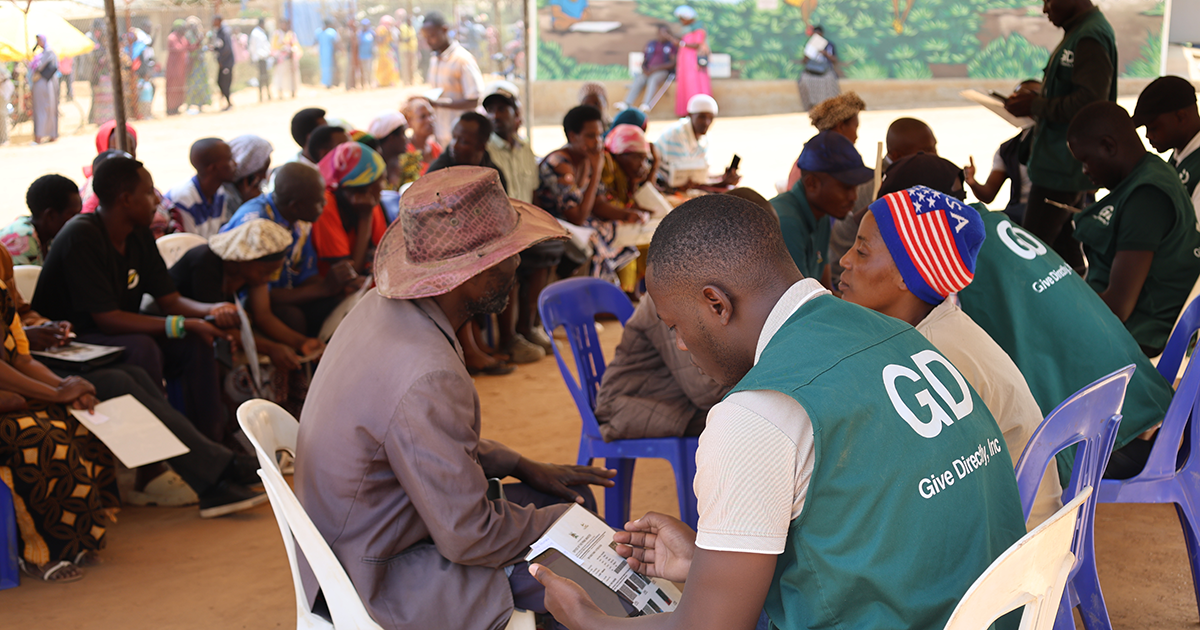
Mathematica’s evaluation of GiveDirectly’s cash-only and cash-plus programs aims to strengthen the limited evidence base on livelihoods for refugees by providing rigorous, casual evidence of the efficacy of cash and cash-plus interventions for refugees in Nakivale. This evidence will inform programmatic decisions at GiveDirectly as it continues to expand its operations in Uganda and other countries and will make an important contribution to the broader policy debate about the most effective approaches to improve refugees’ livelihoods.
Baseline findings of a randomized controlled trial (RCT) of GiveDirectly’s cash transfer program in the Nakivale refugee settlement in Uganda. We assess equivalency between the cash-only group, cash-plus group (receiving a cash transfer and business support services), and control group.
Learn MoreTo solve their most pressing challenges, organizations turn to Mathematica for deeply integrated expertise. We bring together subject matter and policy experts, data scientists, methodologists, and technologists who work across topics and sectors to help our partners design, improve, and scale evidence-based solutions.
Work With Us