
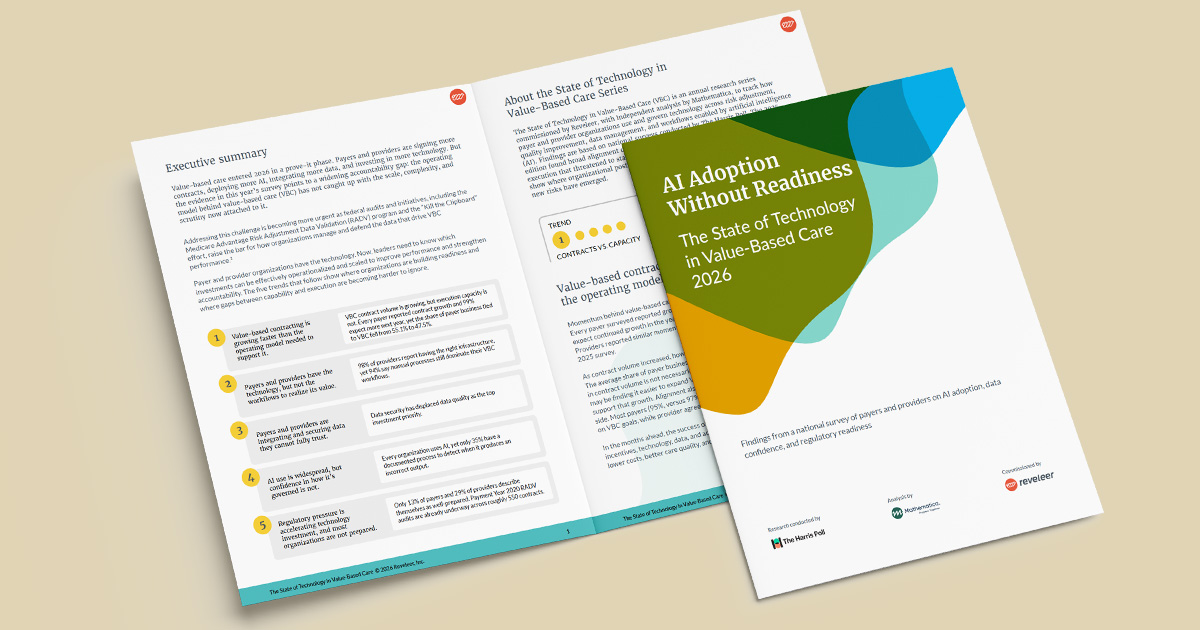
Healthcare payers and providers have invested in AI, data infrastructure, and value-based care technology, but many have yet to build the operational capabilities needed to fully benefit from those investments as regulatory expectations increase, according to the new State of Technology in Value-Based Care report. Commissioned by Reveleer, this 2026 research report draws on a national survey conducted by The Harris Poll and independently analyzed by Mathematica.
The report surveyed 200 senior leaders from payer and provider organizations nationwide and revealed that, although AI adoption is now universal, operational readiness has fallen behind. Only 13 percent of payers and 29 percent of providers describe their organizations as well-prepared for the policy environment of today’s Centers for Medicare & Medicaid Services, even as federal oversight and audit activity continue to expand.
The findings point to a growing readiness gap. Organizations largely have the technology they need, but increasingly complex platforms, manual workflows, and operational challenges continue to limit their ability to translate those investments into operational performance.
“Healthcare has reached an important inflection point where success will depend on how well organizations put technology to work,” said Ngan MacDonald, director of data innovations at Mathematica. “Technology can accelerate progress, but it can’t replace the hard work of understanding how an organization operates. Trusted data, documented processes, and effective governance are what enable organizations to automate with confidence and realize the operational and financial value these technologies were designed to deliver.”
The 2026 report builds on a baseline data set from 2025 to show where organizations are making progress and where critical readiness gaps remain. Key findings include the following:
- Value-based care contracting continues to grow. Every payer and 95 percent of providers report contract growth. Yet increasing contract volume is not necessarily translating into a larger share of payer business.
- Organizations have the technology, but many are still not realizing its full value. Nearly all providers report having the infrastructure needed for value-based care, but 90 percent of providers and 85 percent of payers say their platforms are too complex for effective use. Manual workflows remain widespread.
- Organizations are integrating more data, but data quality remains a persistent challenge. Although 95 percent of organizations rate their ability to integrate data across systems as good or excellent, data quality remains the leading integration challenge for providers (49 percent) and payers (45 percent), even as payers’ investment priorities have shifted from data quality to data security.
- AI adoption is outpacing governance. AI use is universal, but commitment to AI as a strategic priority has declined. Concerns about AI hallucinations continue to grow, and only 35 percent of organizations have a documented process to detect incorrect AI outputs. Furthermore, 93 percent of organizations believe AI vendors have overpromised on their ability to support value-based care performance.
The report concludes that success in value-based care will increasingly depend on building governance practices that make AI-generated insights and operational decisions transparent, explainable, and audit ready.
“The debate over whether healthcare organizations should adopt AI has largely ended," said Jay Ackerman, CEO of Reveleer. "The challenge now is accountability. AI is becoming embedded in decisions that affect reimbursement, quality performance, and regulatory compliance, but adoption alone doesn't create trust. Organizations need to know they can explain how decisions were made, trace them back to trusted clinical evidence, and stand behind them when they're reviewed. As regulatory expectations continue to rise, the organizations that succeed will be those that build accountability, traceability, and transparency into every step of the workflow. Regulators don't review intent. They review records and confirm concrete clinical data."
About Mathematica
Whether strengthening data systems, advancing analytics, or applying AI responsibly, Mathematica is a trusted modernization partner. Mathematica helps clients deliver efficient, effective programs that improve public well-being.
About Reveleer
Reveleer delivers a unified platform spanning risk adjustment, quality improvement, clinical intelligence, and member management for health plans and provider organizations navigating the complexity of value-based care. Trusted by 80+ customer organizations nationwide, the platform integrates data, analytics, and intelligent workflow automation into one governed system designed to support traceable documentation across diagnoses, quality measures, and submissions. With regulatory expertise and transparent, human-in-the-loop AI at its core, Reveleer supports organizations working to advance care quality, strengthen documentation integrity, and sustain the operational readiness needed to navigate audits with confidence.
Media Contact
-
Laura Dyer
Mathematica, Sr. Communications Specialist
ldyer@mathematica-mpr.com
202-912-1064