Projects
Accountable Health Communities Model Implementation Support and Monitoring
2017–2022
The AHC Model is testing whether screening for social needs in clinical settings, referring high-risk Medicare and Medicaid beneficiaries to community services, and helping them navigate those services to address their needs decreases the utilization and cost of health care services.
Social and environmental factors make up 80 percent of the factors that determine a person’s health status, yet they are rarely assessed or addressed by the health care system. Bridging the gap between clinical care and community services may decrease health care costs and improve health.
U.S. Department of Health and Human Services
U.S. Department of Health and Human Services, Centers for Medicare & Medicaid Services
U.S. Department of Health and Human Services, Center for Medicare & Medicaid Innovation
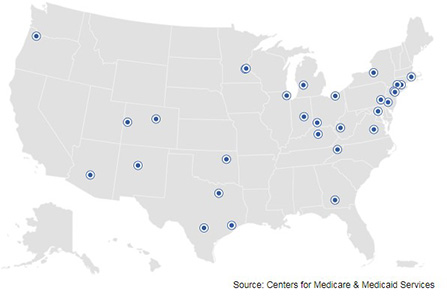
 Health-related social needs such as stable housing, food security, protection from interpersonal violence, utility maintenance, and transportation availability are key drivers of health care utilization and cost. Yet it is often difficult for health care providers and systems to identify such needs and connect patients with appropriate services. To help bridge this gap between clinical care and community services, the Centers for Medicare & Medicaid Services (CMS) launched the Accountable Health Communities (AHC) Model in 2017. The AHC Model initiative is an opportunity to apply a standard approach to identify and address health-related social needs among high-risk Medicare and Medicaid beneficiaries, with the goal of reducing health care utilization and cost. Mathematica supports CMS and AHC Model grantees by providing a peer-learning system, technical assistance, data management, and performance monitoring.
Spotlight on how Ballad Health used the infrastructure it developed through AHC as the foundation for three new screening, referral, and navigation programs. Each new program focuses on a different patient population beyond the population served in the AHC Model.
Learn MoreTo solve their most pressing challenges, organizations turn to Mathematica for deeply integrated expertise. We bring together subject matter and policy experts, data scientists, methodologists, and technologists who work across topics and sectors to help our partners design, improve, and scale evidence-based solutions.
Work With Us